Most people who get in touch about an existing property have the same shape of problem.
They bought something. It has probably performed adequately as a rental. But the price looks wrong in hindsight, the equity isn’t where it should be, and there is a quiet suspicion that the numbers were arranged rather than presented. Meanwhile the plan — the portfolio, the retirement income, whatever it was for — hasn’t moved, because nobody wants to make the next decision until they understand the last one.
That’s not indecision. It’s the reasonable response to being unsure whether you can trust your own read of a market.
You weren’t foolish
I have no interest in a story where the buyer was daft. The people I sit across from have usually done more homework than whoever is telling them not to be a mug.
The information generally wasn’t hidden from them. It was arranged. Gross where net would have been less flattering, projected where achieved was available, every individual figure true and the conclusion wrong. A reasonable person, handed that arrangement, reaches the wrong answer reasonably.
Which is why the useful question isn’t how did I get this wrong. It’s what is this actually worth to me now, and what do I do next.
Two questions, not one
Nearly everyone in this position is holding two problems and treating them as one.
The first is the property itself. Hold it, borrow against it, or replace it — and whether all three of those are even available to you, which depends on numbers most people haven’t put side by side. Some of the options people assume they have turn out to have closed years ago without anybody telling them.
The second is everything after. What to buy, in what order, on what basis — and how to test the next opportunity without relying on the judgment of whoever is selling it.
They need answering in that order, but they need answering together. Solve the first alone and you have a decision with nowhere to go. Solve the second alone and you’re building on top of something unresolved.
What’s included
The audit
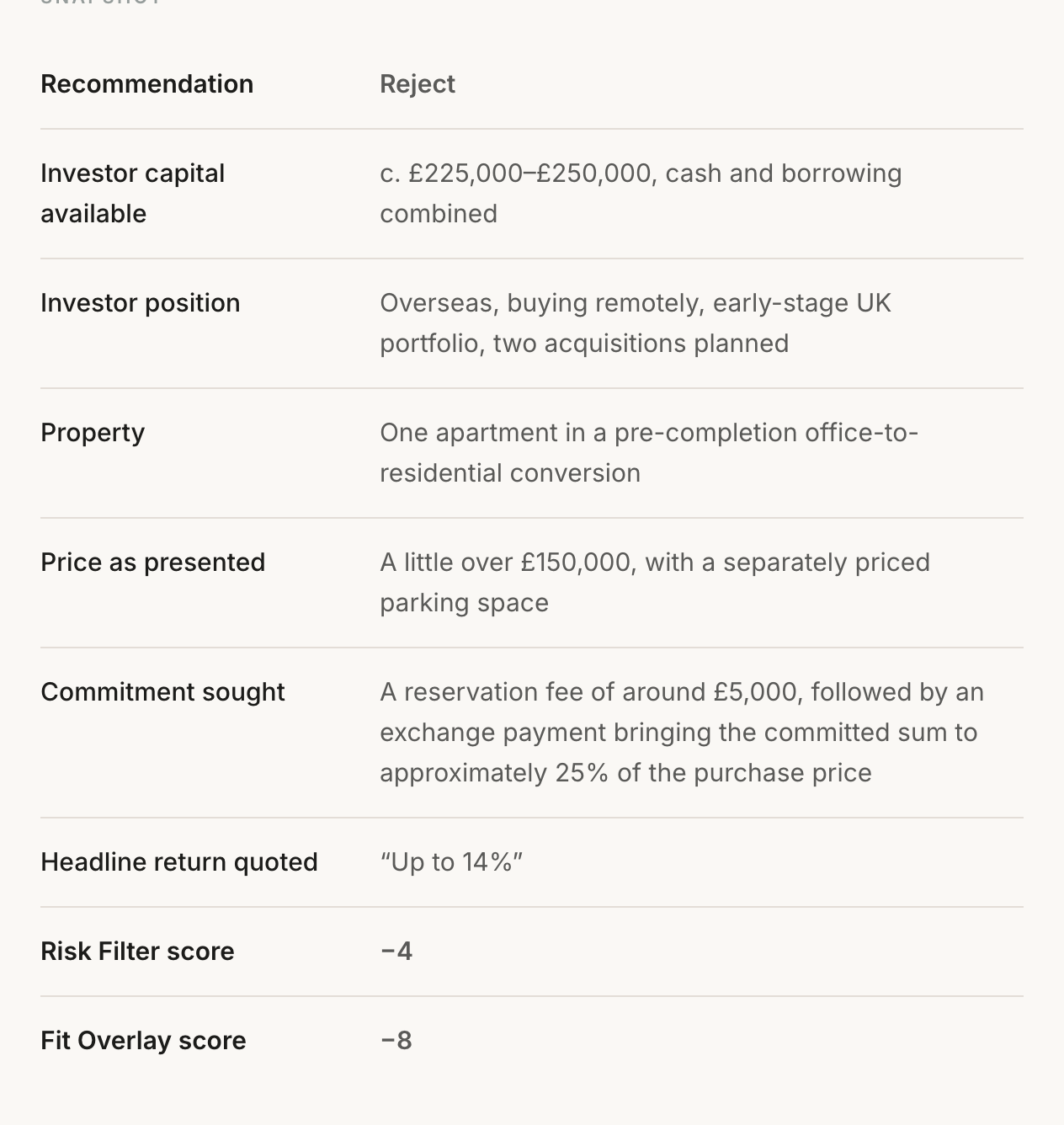
A call to establish the position properly, a written document that scores the property against the same framework used in the published case studies, and a second call to take you through it. It reaches a recommendation, not a summary.
Written document + two calls · within 15 working days
The forward plan
Written and specific to you. What to look for next, what to avoid, the order things should happen in, and what has to be true before each step.
Written · delivered with the audit
The Framework
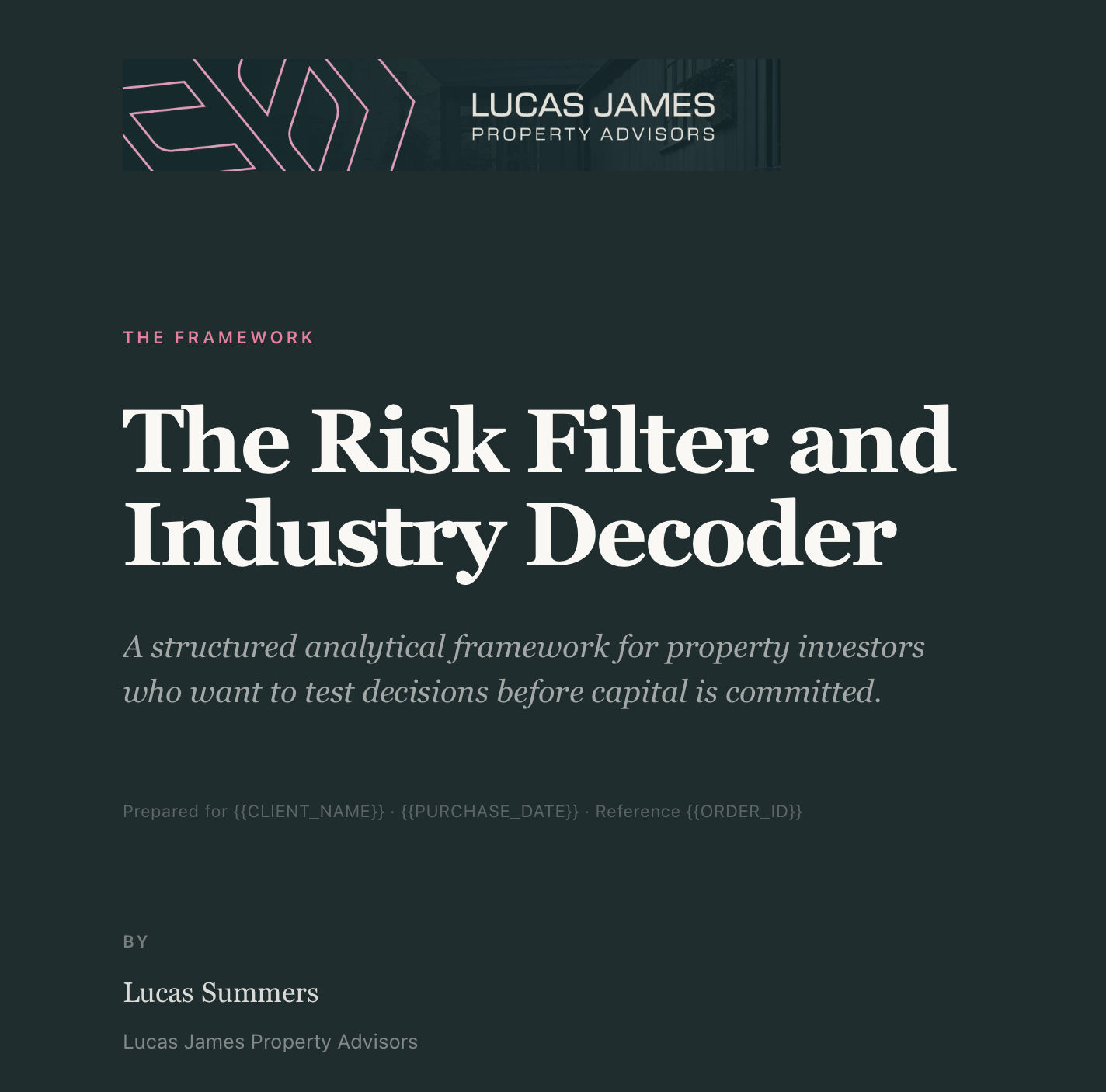
The Risk Filter and the Industry Decoder — the instrument used in the audit, so you can run the same test on anything anybody shows you afterwards.
Delivered on engagement
Twelve months of deal flow
Anything that crosses my desk unallocated gets sent to you if it clears both the Risk Filter and your own profile. It’s what comes past me in the ordinary course of working, not a search, and there’s no guaranteed volume. Nothing arrives that hasn’t been scored. I take no payment from any vendor, agent or introducer, in any circumstances.
Ongoing · 12 months from engagement
All four, for one property — £3,000. The audit on its own, without the forward plan, is from £1,500.
The fee is the same whether the recommendation is to hold it, borrow against it, sell it, or do nothing at all this year. Nobody pays me anything else, from anywhere, at any point.
What it isn’t
I don’t look for property on your behalf, attend viewings or negotiate — that’s a separate engagement. I don’t give regulated financial advice, and I don’t advise on pensions, investments other than property, or specific mortgage products. Tax and legal questions go to your accountant and your solicitor, and I’ll say so when they arise.
I’m also not a surveyor. This is an assessment, not a valuation.
Two documents, both published in full
You don’t have to take my word for how the analysis works. Two real audits are on this site, unredacted.
One concluded proceed, with conditions. One concluded reject — and the client didn’t buy it. I was paid the same for both.
Read the first case study → Read the second →If that sounds like your position
Send me a note about the property — where it is, roughly what you paid, and what’s prompted you to look at it now. If it’s something I can help with I’ll say so, and if it isn’t I’ll say that instead.
Get in touchYou’ll receive a reply within one working day with two or three specific time options. Fit calls are by phone.